app_localeMedicare honlap
Nyelvválasztás megjegyzése.
1 év
first-party

Laboratory tests can help identify or, where appropriate, rule out the underlying diseases.
However, it is important to highlight that the result of a laboratory test does not in itself constitute a diagnosis, only the results are included in the finding. You will receive the diagnosis, therapy or treatment recommendation from your specialist or treating physician who ordered the laboratory tests.
Contact your doctor with all laboratory test results.
Our colleagues are happy to help!
Our colleagues are happy to answer every question!
Tumour types and their markers
| Tumour marker | Full name | Oncology field |
| AFP | Alfa-foetoprotein | Liver and egg cell tumours |
| CA 125 | Cancer antigen 125 | Ovary tumour |
| CA 19-9 | Cancer antigen 19-9 | Pancreatic tumour |
| CA 15-3 | Cancer antigen 15-3 | In case of breast cancer |
| CEA | Carcinoembryonic antigen | Digestive organ tumours |
| PSA | Prostate antigen | Prostate cancer |
| PSA free | Prostate-specific antigen | Prostate cancer |
| Septin 9 | Septin-9 | Colon cancer |
| S-100 | S-100 | Melanoma |
| Bone trap 5B | Bone trap 5B | Bone tumour, bone metastasis |
| Cyfra-21 | Cyfra-21 | Not small cell lung cancer |
| TPA | Tissue polipeptid antigene | Possible tumour marker: breast, lung, bladder and ovarian cancer |
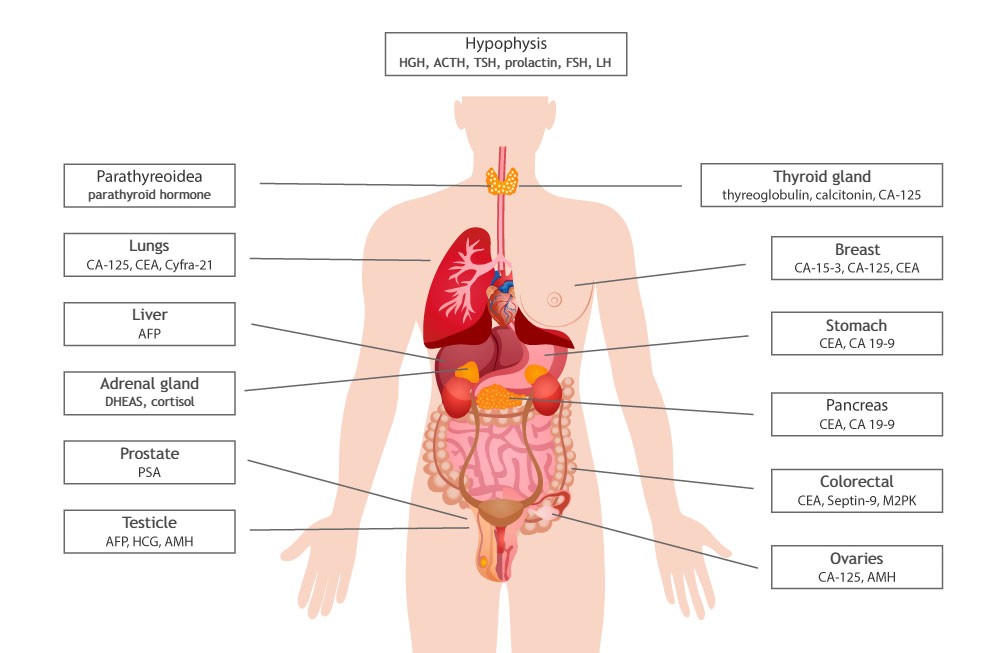
Tumour markers are produced by tumour cells. The laboratory can detect these substances from body secretions: blood, urine, cerebrospinal fluid, faeces. Tests make sense if there are any complaints or symptoms that raise the possibility of a tumour. If the tumour marker test is performed before the tumour therapy, the tracking of the parameter is suitable for monitoring the effectiveness of the therapy and for indicating the recurrence of the tumour.
A negative test result (the tumour marker concentration is in the normal range) does not necessarily indicate a tumour-free condition, as a positive result does not necessarily indicate cancer. In a positive case, further tests can be used to determine if there is indeed a cancerous lesion. Among other things, one of the most common types of cancer, colon cancer, can be screened for with laboratory testing of blood and stool samples.
Please note that the tests performed do not give a diagnosis, it is the responsibility of your doctor to evaluate the results and establish the diagnosis.
Informational content only The textual content published on this page is for general information purposes only and does not constitute medical advice, a diagnosis, or a treatment recommendation. Proper assessment, examination, and therapeutic decisions always require a personal medical consultation and, where appropriate, further specialist opinion. Medicare Egészségközpont Zrt. makes every reasonable effort to keep the content up to date; however, it accepts no liability for the completeness or accuracy of the information published or for consequences arising from decisions based on it.