app_localeMedicare honlap
Nyelvválasztás megjegyzése.
1 év
first-party

Since we use our knee every day, almost every minute, it is at risk of wear and accidents. If your knees are so worn out or you have an accident so severe that the damage is irreversible, in many cases only implanting a full knee replacement can help.
Our colleagues are happy to help!
Our colleagues are happy to answer every question!
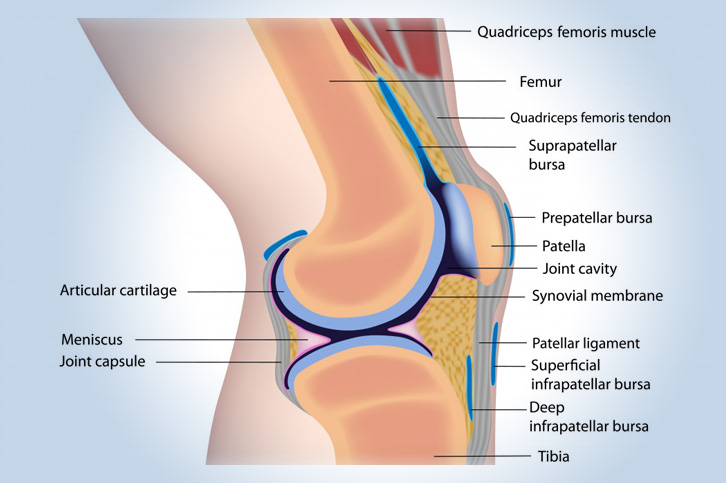
The knee is the largest and most complex joint in our body, which performs rolling and rotational movements of moderate degree during operation. It plays an essential role in movement when carrying weight in the horizontal (running and walking) and vertical (jumping) directions.
It actually consists of two real (femur and tibia, femur and kneecap) and one non-real joint (the end of the tibia and fibula near the knee). The meniscus (C-shaped elastic fibrous cartilage) is located between the articular surfaces (hard hyaline cartilage) of the femur and tibia, which reduces the shape difference of continuously changing surfaces during movement due to their elastic properties.
Based on these, if, despite conservative treatment, walking causes pain in everyday life, or you can no longer sleep through the night because of pain, an orthopaedic specialist examination is needed, based on which your treating physician can decide what surgical treatment you may need, which may include the implantation of a knee prosthesis.
In our hospital, we perform primary total knee replacement surgery based on indication confirmed by preliminary examinations. During this process, our knee specialist orthopaedic surgeons replace the worn joint surfaces of the knee with an artificial prosthesis. This allows almost complete original stable movement of the knee.
At our hospital, the procedure is performed under regional (i.e. spinal) or general anaesthesia. The type of anaesthesia is decided by your doctor depending on your medical condition.
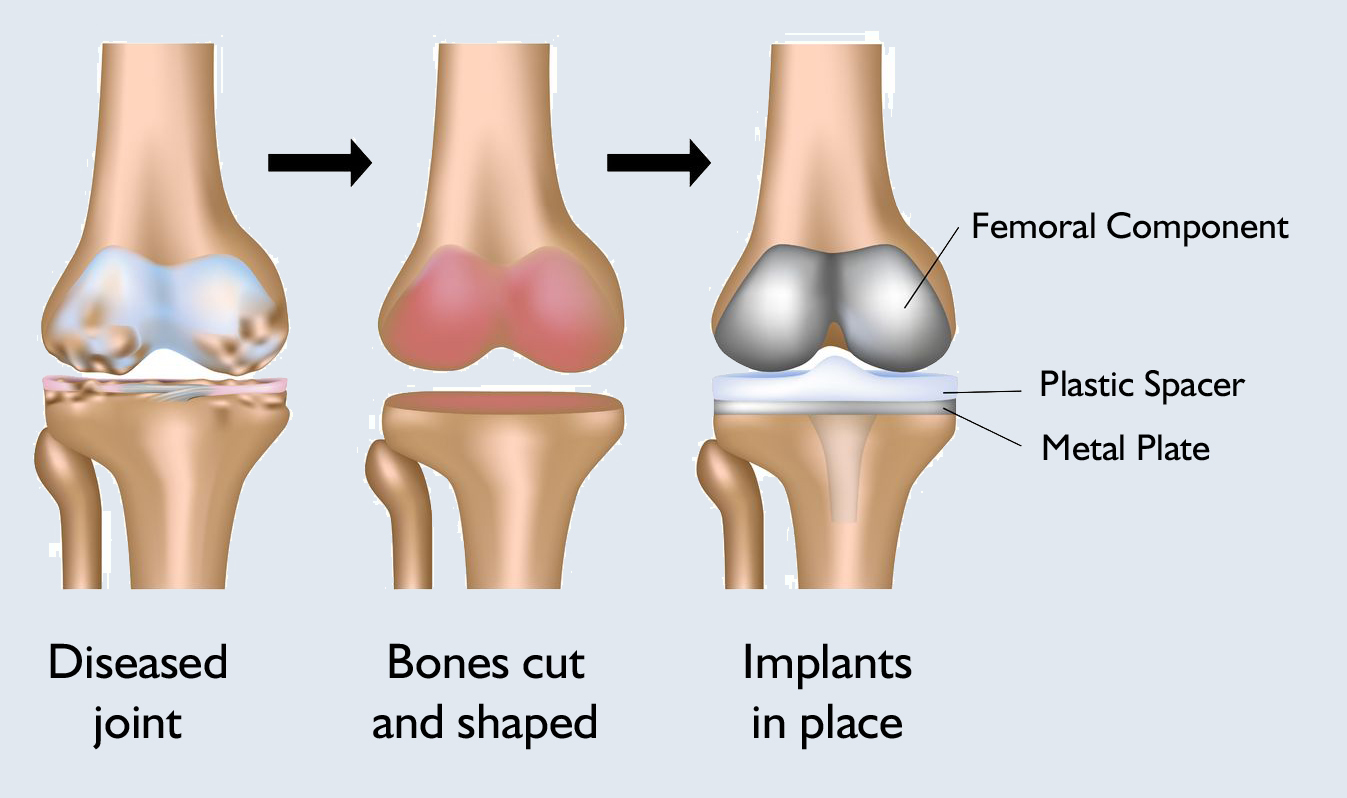
Knee replacement surgery is performed with a special bleeding cuff placed on the thigh to minimize blood loss. After proper anaesthesia, an approximately 20-centimeter incision is made above the kneecap, through which the surgeon exposes the joint. Worn cartilage surfaces are removed and templates are used to create the location of the knee prosthesis.
By inserting a test prosthesis, we check the stability and the range of motion.
Metal components of a predetermined size are glued with special antibiotic bone cement, between which a plastic lining is inserted to ensure proper movement and friction. Depending on the condition of the kneecap, a plastic “button” may also be used to replace the articular surface of the kneecap. If the movement and stability of the final components are adequate, thorough haemostasis is performed and then the tissues are layered over a drain tube to remove any haematoma that may form. A sterile dressing and elastic bandage are then applied.
To select the right knee prosthesis, functional X-rays, and in some cases CT scans, are required.
There is a risk of infection during knee replacement surgery, so a fuller examination is needed to prevent this:
One of the most important parts of postoperative knee replacement surgery is rehabilitation and early functional treatment of the knee.
To do this, it is extremely important to reduce postoperative pain, which is performed in the immediate postoperative period with a so-called EDA (EpiDural Anesthesia) cannula, which can be used to significantly reduce pain with an aesthetic placed in the epidural space.
Additionally, on the day after the knee replacement surgery, the drain is removed and physiotherapy treatment begins, which includes exercises that relieve the knee, assistive device mobilization, and CPM treatment, i.e. machine-controlled passive movement of the knee.
This happens every day of the postoperative period, and after 3-4 days you can leave our hospital and continue rehabilitation at home, with a complete physiotherapy program. Learning and doing gymnastic exercises regularly is very important to achieve painless movements as soon as possible.
It is extremely important for a good end result that you work properly with your physiotherapist, start and do physiotherapy on time to avoid joint mobility limitations and other problems.
All interventions thus knee replacement surgery also involve risks. Despite the most careful examination, unexpected complications may occur. Therefore, an extremely thorough examination is necessary, during which we recommend postponing the operation in all cases that would put you at increased risk.
In each case, your doctor will decide, based on preliminary tests, what the risks are. An anaesthesiologist is also consulted to determine the risk more accurately. The results of the tests and consultation with the anaesthesiologist are crucial.
We accommodate our clients in a modern, pleasant, air-conditioned single room. Each room has a private bathroom, fridge and TV, and free WIFI access. We also provide our clients with individual nurse supervision, who will help your continuous recovery during your stay along with the regular physiotherapy sessions.
Informational content only The textual content published on this page is for general information purposes only and does not constitute medical advice, a diagnosis, or a treatment recommendation. Proper assessment, examination, and therapeutic decisions always require a personal medical consultation and, where appropriate, further specialist opinion. Medicare Egészségközpont Zrt. makes every reasonable effort to keep the content up to date; however, it accepts no liability for the completeness or accuracy of the information published or for consequences arising from decisions based on it.