app_localeMedicare honlap
Nyelvválasztás megjegyzése.
1 év
first-party

C-reactive protein (CRP) is a protein produced by the liver. It enters the bloodstream during bacterial infections, tissue damage, and inflammatory processes, where it recognizes the special membrane protein of damaged or foreign cells to which it is attached. In this way, phagocytes recognize the cells to be removed and incorporate them.
CRP helps fight infections and remove toxic substances from the blood after tissue damage.
In the event of an infection or inflammation, the CRP level can rise to ten or even a hundred times the normal value within a few hours, which closely follows the changing of the inflammatory condition. Therefore, the test is suitable for detecting the presence of inflammatory processes (e.g. autoimmune conditions such as inflammatory bowel disease, rheumatoid arthritis) as well as infections caused by viruses, bacteria or fungi, as well as for monitoring their course and determining the effectiveness of treatment.
However, the test is not specific, it does not show the location of the inflammation or the possible pathogen, so it is not suitable for diagnosing a disease on its own.
In our laboratory, we perform the high-sensitive hs-CRP test, the results of which can also be used to determine the risk of heart failure.
The determination of the CRP level is most often ordered by the specialist to detect the underlying inflammation due to a disease, or in case of suspicion of acute inflammation (e.g. after surgery).
The test can also be used to monitor the course of certain autoimmune diseases (rheumatoid arthritis, lupus, ulcerative colitis, Crohn’s disease) and the effectiveness of treatment.
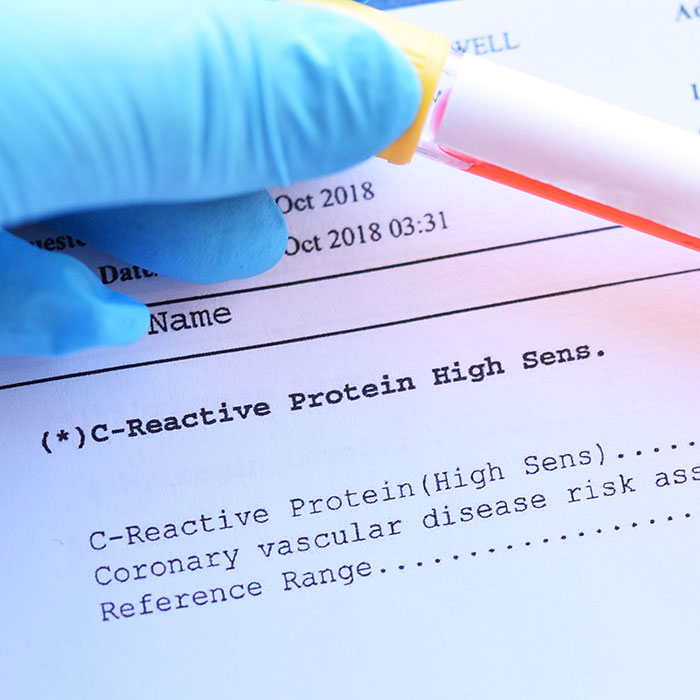
A blood sample taken from a vein is needed to perform the test.
If the CRP value is in the normal range or very low, there is no inflammation in the body.
Significantly elevated CRP values indicate inflammation or acute infection in the body, which can be caused by viruses, bacteria, or fungi. The exact cause of these can be determined by further examination.
Slightly elevated CRP values may be associated with the development of cardiovascular disease. In this case, it is recommended to visit a cardiologist for an examination.
The obtained result does not constitute a diagnosis in itself, in all cases it is necessary to perform further examinations in order to determine the exact cause of the inflammation or infection. Contact the specialist or treating physician who ordered the test, who will recommend appropriate therapy.
Informational content only The textual content published on this page is for general information purposes only and does not constitute medical advice, a diagnosis, or a treatment recommendation. Proper assessment, examination, and therapeutic decisions always require a personal medical consultation and, where appropriate, further specialist opinion. Medicare Egészségközpont Zrt. makes every reasonable effort to keep the content up to date; however, it accepts no liability for the completeness or accuracy of the information published or for consequences arising from decisions based on it.