app_localeMedicare honlap
Nyelvválasztás megjegyzése.
1 év
first-party

The Chromogranin A (CgA) test can be used to diagnose carcinoid tumours and other tumours originating from neuroendocrine cells, and to monitor the effectiveness of the therapy of the disease being treated.
Neuroendocrine cells are found in many parts of the body and work through nervous and hormonal regulation. Neuroendocrine tumours develop in these cells and form a rare subgroup of cancerous diseases.
This group of tumours must be distinguished from other tumour types, as neuroendocrine tumours in almost all cases produce – or have the potential to produce – hormone-like substances that most tumours do not.
These hormone-like substances are produced continuously or intermittently by ill cells and enter the bloodstream, therefore they can be detected by a specific blood test.
Neuroendocrine tumours can occur in almost all organs of the human body, most commonly from the gastrointestinal tract and the mucous membranes of the pancreas and bronchial system.

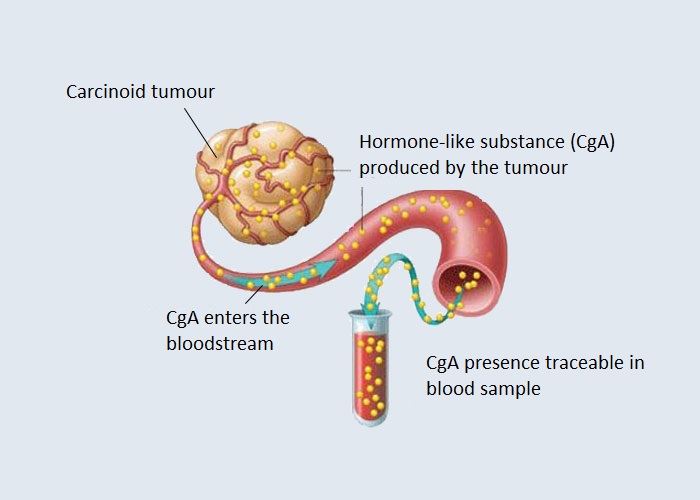
Carcinoid tumours are one of the most common types of neuroendocrine tumours, usually developing in the digestive system (stomach, small intestine, colon, rectum) or lung. They do not cause symptoms for a long time, or only milder symptoms appear depending on the location of the tumour.
Common symptoms of tumours in the lungs include shortness of breath, chest pain, wheezing, and redness on the face and neck. Long-term abdominal pain and severe diarrhoea and redness of the face are typical of gastrointestinal tumours.
The occurrence of symptoms is often attributed to irritable bowel syndrome, so it is recommended that a chromogranin test be performed if these symptoms persist.
The Chromogranin A test helps clearly diagnose carcinoid tumours and to detect the presence of other hormone-producing and hormonally inactive neuroendocrine tumours.
The concentration of Chromogranin A correlates with the activity and the size of the tumour, so the test is also used to monitor the disease, as an increase in CgA indicates the progression of the tumour process and the growth of the tumour. It is primarily suitable for the detection of carcinoid tumours in the anterior and postoperative.

Chromogranin A laboratory tests are usually prescribed by your doctor if you have a suspected neuroendocrine tumour or carcinoid tumour based on your medical history.

Chromogranin A levels in the blood are usually low, elevated levels with symptoms may be a sign of a neuroendocrine tumour.
In light of the laboratory test result, the attending physician will order additional imaging tests to determine the location of the tumour and then make a diagnosis. If the test is aimed at monitoring the disease, a decrease in CgA levels indicates tumour shrinkage and demonstrates the effectiveness of the treatment.
CgA levels may be increased in case of certain diseases, such as liver disease, irritable bowel syndrome, impaired kidney function, stress, or when taking certain medications, such as stomach acid. These possible causes should also be considered when evaluating elevated CgA levels, so it is always the responsibility of a physician to make a diagnosis.
It is important to know that the tests used by each laboratory may be different, so tests performed at different locations are not comparable. Disease monitoring is therefore only possible by a test performed in the same laboratory.
The laboratory test is performed on a blood sample. Having an empty stomach is not required prior to sampling.
The results of the test may be affected by taking a proton pump inhibitor (PPI), so treatment should be stopped the week before the test.
Sampling is done with a sampling needle inserted into one of the veins of the crook of the arm.
On the 15th working day following the examination.
Informational content only The textual content published on this page is for general information purposes only and does not constitute medical advice, a diagnosis, or a treatment recommendation. Proper assessment, examination, and therapeutic decisions always require a personal medical consultation and, where appropriate, further specialist opinion. Medicare Egészségközpont Zrt. makes every reasonable effort to keep the content up to date; however, it accepts no liability for the completeness or accuracy of the information published or for consequences arising from decisions based on it.